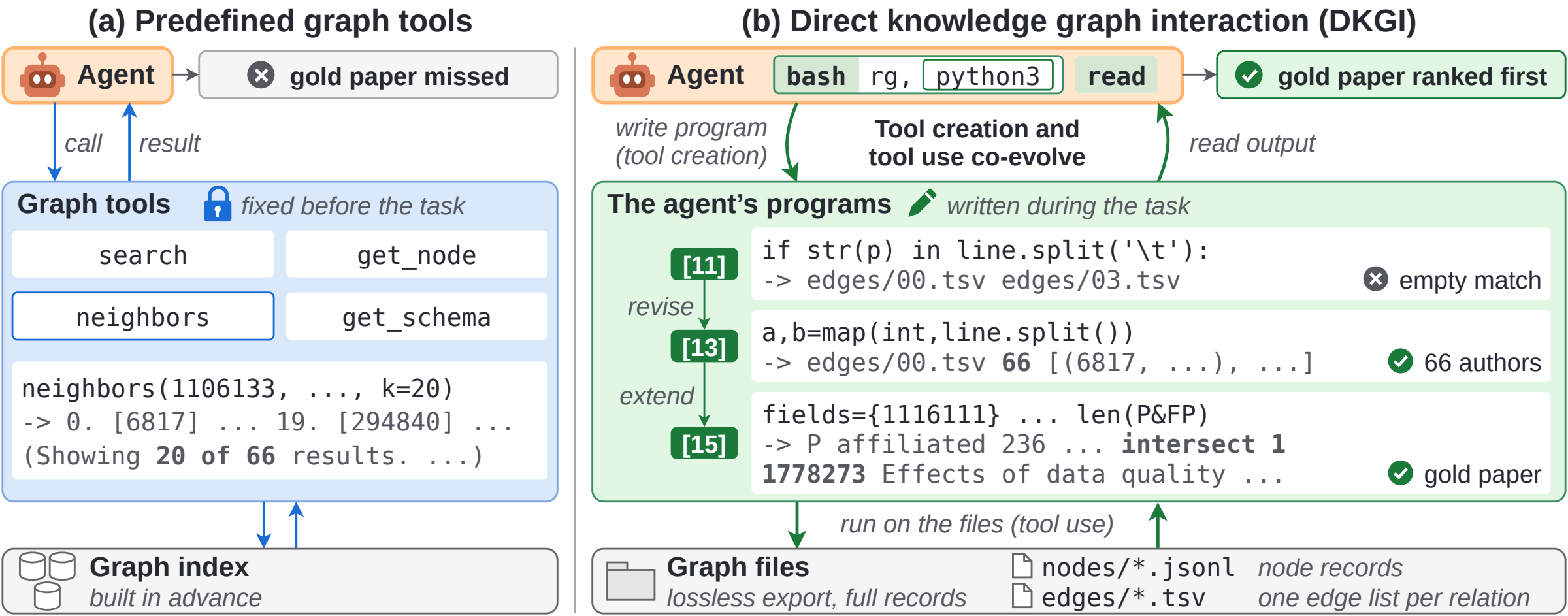
Searching text-rich knowledge graphs requires following relations while examining textual evidence. Predefined graph interfaces constrain what evidence agents can access, even when they write code to combine tool calls or process retrieved subgraphs. We propose direct knowledge graph interaction (DKGI), a harness in which language model agents create graph access tools directly over complete node and edge files. The agent writes Python code to follow relations, combine node sets, and select textual evidence, interleaving execution with shell search and file inspection. This lets agents process large node sets in bulk while returning selected text for the model to assess. Execution feedback guides tool creation and revision, while the evolving tools determine what evidence the agent gathers next. On benchmark datasets spanning three domains, training-free DKGI exceeds the strongest published baseline by at least 6.7 Hit@1 points on every graph, even with a minimal harness. Controlled ablations show the benefits of multi-turn programming over shell-only access and predefined graph tools, while trajectories show agents revising code to extend searches or address errors. These findings highlight the value of allowing tool creation and tool use to co-evolve during graph search.
Existing methods typically access the graph through specialized interfaces: database query languages, retrievers that return reasoning paths or subgraphs, and tools for entity search, node lookup, and neighbor expansion. Some agents write code that combines predefined graph tool calls, while others generate code to traverse graph objects provided by a dedicated subgraph retriever. Across these designs, access to the underlying graph remains governed by a predefined interface. DKGI exposes textual node records and typed graph relations as files, together with the graph schema, and lets the agent implement graph access directly over the complete node and edge files.
| Predefined | Written by the agent | |||
|---|---|---|---|---|
| Setting | graph API / retriever | code | revisions | direct file access |
| ① Direct tool use ToG, Graph-CoT, ARK, GRASP; Graph tools |
✓ | – | – | – |
| ② Code over a graph interface semantic parsing, KG-Agent, Code-on-Graph, AvaTaR; Graph tools + code |
✓ | ✓ | (✓) | – |
| ③ Direct knowledge graph interaction Full DKGI |
– | ✓ | ✓ | ✓ |
Table 1: Graph access and agent-written code across three settings. Direct file access lets agent-written code access all node and edge files without a predefined graph API or subgraph retriever. “(✓)” indicates support in some systems. Italicized entries denote our controlled variants.
On the same request, DKGI writes and revises graph access code (tool creation) and executes it to gather evidence (tool use). Execution feedback guides which access operations to create or refine. The resulting code, in turn, changes how the agent explores the graph and what evidence it obtains. Tool creation and tool use thus co-evolve: the agent develops its tools as it searches, and its evolving tools guide the subsequent search.
We evaluate DKGI as a training-free method on the three knowledge graphs of the STaRK benchmark (Amazon, MAG and Prime), in the minimal Pi harness and in the more feature-rich Codex CLI. Even in Pi, our best DKGI configuration exceeds the strongest published baseline (GRASP) by at least 6.7 Hit@1 points on every dataset.
| Amazon | MAG | Prime | |||||||
|---|---|---|---|---|---|---|---|---|---|
| Method | H@1 | R@20 | MRR | H@1 | R@20 | MRR | H@1 | R@20 | MRR |
| Trained or tuned on STaRK | |||||||||
| AvaTaR | 49.9 | 60.6 | 58.7 | 44.4 | 50.6 | 51.2 | 18.4 | 39.3 | 26.7 |
| PASemiQA | 45.9 | – | 55.7 | 43.2 | – | 50.2 | 29.7 | – | 31.0 |
| mFAR (All+2) | 53.0 | 66.3 | 64.3 | 55.9 | 74.1 | 64.3 | 40.0 | 72.6 | 52.0 |
| MoR | 52.2 | 59.9 | 62.2 | 58.2 | 75.0 | 67.1 | 36.4 | 63.5 | 46.9 |
| GraphRAFT | – | – | – | 69.6 | 89.1 | 76.2 | 63.7 | 76.4 | 69.0 |
| GRASP | 71.2 | 70.6 | 78.7 | 82.8 | 91.5 | 88.3 | 67.8 | 88.1 | 76.8 |
| Training-free | |||||||||
| BM25 | 44.9 | 53.8 | 55.3 | 25.9 | 45.7 | 34.9 | 12.8 | 31.3 | 19.8 |
| ColBERTv2 | 46.1 | 53.4 | 55.5 | 31.2 | 43.9 | 38.4 | 11.8 | 25.0 | 17.4 |
| GritLM-7B | 42.1 | 56.5 | 53.5 | 37.9 | 46.4 | 47.3 | 15.6 | 39.1 | 24.1 |
| KAR | 54.2 | 57.2 | 61.3 | 50.5 | 60.3 | 57.5 | 30.4 | 50.8 | 39.2 |
| HybGRAG | – | – | – | 65.4 | 65.7 | 69.8 | 28.6 | 43.6 | 34.5 |
| AF-Retriever† | 61.2 | 35.5 | 67.3 | 78.6 | 61.4 | 84.0 | 46.2 | 51.2 | 54.0 |
| ARK | 56.1 | 58.6 | 65.7 | 73.1 | 86.2 | 81.0 | 50.6 | 70.0 | 59.6 |
| KG reasoning methods adapted to STaRK by Yang et al. (2025), with GPT-4‡ | |||||||||
| ToG | 16.7 | – | 21.2 | 5.4 | – | 6.1 | 13.2 | – | 15.8 |
| RoG | 31.2 | – | 36.0 | 32.9 | – | 38.7 | 22.7 | – | 25.2 |
| GoG | 21.0 | – | 26.3 | 41.3 | – | 47.8 | 18.9 | – | 21.1 |
| Ours: direct knowledge graph interaction (training-free) | |||||||||
| DKGI (Pi, GPT-6-Luna) | 57.8 | 58.1 | 64.7 | 88.0 | 88.4 | 89.8 | 63.8 | 78.9 | 70.4 |
| DKGI (Codex, GPT-6-Luna) | 59.8 | 55.2 | 66.2 | 88.0 | 88.1 | 89.6 | 66.6 | 80.9 | 72.4 |
| DKGI (Pi, GPT-6-Astra) | 79.4 | 71.1 | 84.0 | 91.8 | 93.2 | 93.2 | 74.5 | 86.1 | 79.1 |
Table 2: H@1, R@20 and MRR on the synthetic test sets of STaRK. Bold marks the best value in each column. Baseline numbers are published values (backbones in the paper's appendix), and a dash marks a value absent from the source paper. †R@20 from the complete-pipeline row of its ablation table. ‡From the H@1 and MRR tables of Yang et al. (2025). The DKGI rows cover the full test sets (7,108 queries) and share the prompt and the time limit.
We fix the model (GPT-6-Luna), the harness (Pi), the budgets and the prompt apart from its tool section, and vary which actions the agent can take. A 2×2 design crosses graph access (the graph files or predefined graph tools based on ARK) with Python. All variants run on STaRK's test subset (710 queries).
| H@1 | Overall | ||||||||
|---|---|---|---|---|---|---|---|---|---|
| Variant | Graph access | Python | Amazon | MAG | Prime | Overall | Δ | R@20 | MRR |
| Full DKGI | node and edge files | ✓ | 59.1 | 91.0 | 69.6 | 75.2 | – | 78.0 | 78.9 |
| Shell only | node and edge files | – | 48.8 | 86.1 | 62.9 | 68.3 | −6.9 | 69.5 | 72.0 |
| Graph tools + code | predefined graph tools | ✓ | 60.4 | 90.2 | 67.1 | 74.2 | −1.0 | 79.4 | 78.9 |
| Graph tools | predefined graph tools | – | 59.8 | 87.6 | 66.4 | 72.8 | −2.4 | 79.5 | 77.6 |
| One program | node and edge files | once | 48.2 | 87.2 | 63.9 | 69.0 | −6.2 | 70.8 | 72.5 |
| Retrieval only | search, get_node, get_schema | – | 58.5 | 48.5 | 40.7 | 47.7 | −27.5 | 55.1 | 53.9 |
| No edges | node files | ✓ | 49.4 | 45.5 | 40.0 | 44.2 | −31.0 | 52.6 | 50.6 |
| Full DKGI (Codex) | node and edge files | ✓ | 58.5 | 87.6 | 67.5 | 73.0 | −2.3 | 75.5 | 76.9 |
Table 3: Ablation on the test subset (710 queries) with GPT-6-Luna in Pi, unless marked Codex. Python: ✓ over several turns, “once” for a single program per query, and – for no Python access. The first four rows form the 2×2 design, the fifth row limits Python to one program, and the last three rows are controls. Δ: overall H@1 minus that of Full DKGI.
Figure 2: Behavior of Full DKGI (Pi, GPT-6-Luna) on the full test sets. (a) Python commands, rg searches and other calls (mostly read) by position in the trajectory. (b) Programs by operation type (types overlap). The blue types have counterparts among predefined graph tools. (c) Error types of incorrectly answered queries.
rg searches, and Python makes up 83.3% of the calls in its last 20%. The agent writes 4.0 programs per query on average.neighbors at least ten times, Full DKGI leads them by 9.0 and 6.0 H@1 points.| Resource | Content | License |
|---|---|---|
| leopoldwhite/DKGI | code that exports the STaRK graphs to files, runs every configuration and computes the paper's numbers; exact prompt texts | MIT |
| yuyangbai/DKGI-STaRK-Graphs | the exported node and edge files, questions and labels of the three STaRK graphs | CC BY 4.0 |
| yuyangbai/DKGI-Trajectories | for every test configuration and question: the agent's trajectory, its answer and its scores | CC BY 4.0 |
@misc{bai2026dkgi,
title = {Knowledge Graphs as Files: An Agent Harness Where Tool Creation and Tool Use Co-Evolve},
author = {Bai, Yuyang and Wang, Yu and Zhang, Yu},
year = {2026}
}